Mitchell fifty guides New Zealand’s lead past 400 at The Oval
New Zealand Tighten Grip on Fourth Morning at The Oval
On a pivotal fourth morning at The Oval, New Zealand consolidated their overwhelming dominance over England, pushing their lead well beyond the reach of a standard chase. Resuming their second innings in an already commanding position, the visitors batted with composure and calculated aggression to systematically bat England out of the game. A stellar performance from the middle order ensured that the Kiwis piled on the runs, making the prospect of an English comeback look increasingly improbable. By the time the players walked off for lunch, the lead had swelled to an intimidating 445 runs, leaving the hosts facing a monumental task.
Archer’s Early Fire and the Costly Drop
England’s hopes of a rapid morning breakthrough rested largely on the shoulders of Jofra Archer, who bowled with fierce pace and intent from the Pavilion End. Archer looked dangerous from his very first delivery, which could have dismissed Daryl Mitchell had Harry Brook managed to hold onto a difficult, diving catch at slip. It was a reprieve that England would quickly come to regret.
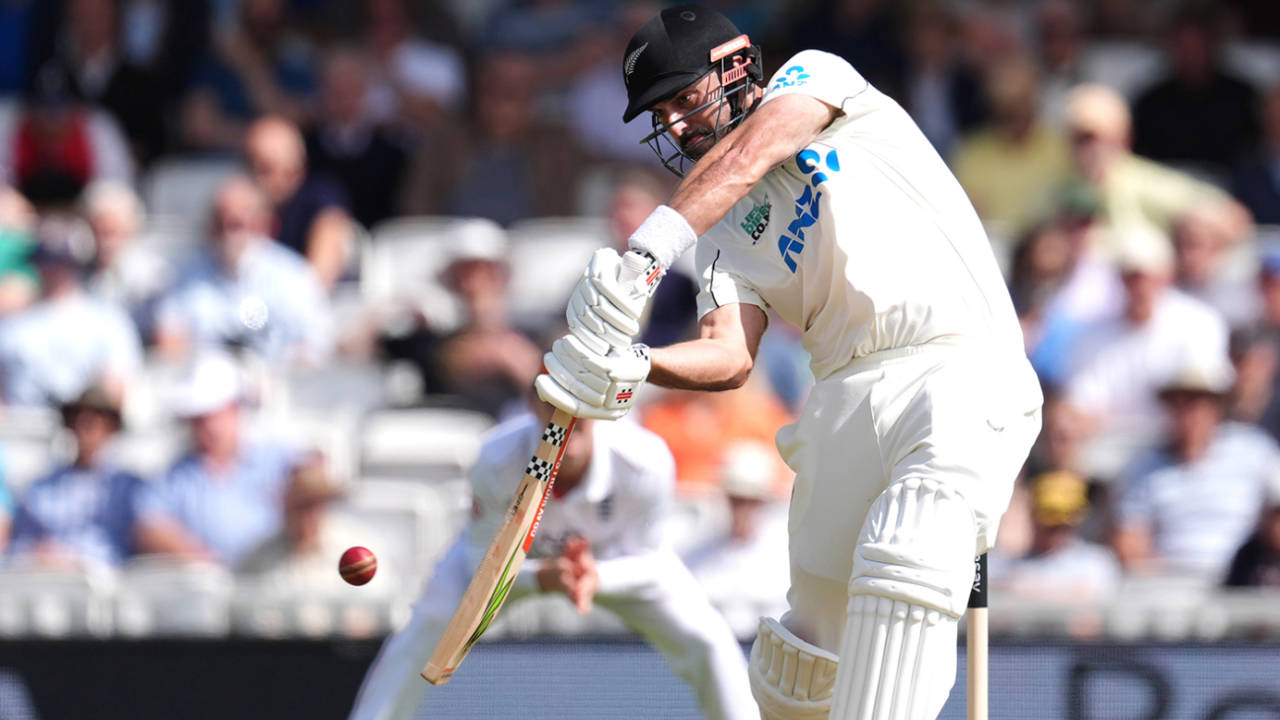
Although Archer struck in his next over—dismissing the overnight centurion Henry Nicholls for 121, thanks to a much simpler catch by Brook, who had been repositioned to second slip—the damage was already being initiated by Mitchell. Seizing on the missed opportunity, Mitchell played with growing confidence. He targeted the off-spin of Joe Root, bringing up his half-century in style by dispatching Root for three boundaries in a single over. This clinical display of batting shifted the pressure back onto the English bowlers, who struggled to maintain consistent line and length against a determined Kiwi batting lineup.
Mitchell and Blundell Etch Their Names in History
The morning session was not just about accumulating runs; it also featured historic milestones. Following the departure of Nicholls, Tom Blundell joined Mitchell at the crease. While their partnership was relatively brief at 29 runs, it was historic. During this stand, Blundell and Mitchell became the first New Zealand pair to cross the milestone of 1,000 partnership runs in Test matches against England. This achievement underscores their long-standing reliability and chemistry in the middle order, which has frequently rescued and consolidated New Zealand’s positions in recent years.
England did manage to break this partnership through a touch of fortune. Joe Root, stationed at leg slip, nearly dropped a sharp chance offered by Blundell. However, the ball juggled out of his hands only to be alertly scooped up by wicketkeeper James Rew on the rebound. It was a crucial breakthrough for England, but one that did little to stem the overall flow of runs.
Middle-Order Resistance and Smith’s Flurry
Jofra Archer remained the primary threat for England, bowling an exhaustive spell of eight out of the first nine overs from his end. His persistence paid off once more when he accounted for first-innings centurion Glenn Phillips. Phillips, looking to accelerate, was undone by Archer’s extra bounce and was caught brilliantly by Jacob Bethell in the gully.
Despite losing wickets at regular intervals, New Zealand’s lower-middle order showed no signs of retreating. Nathan Smith joined the set Mitchell and immediately took the attack to the English spinners. Smith showed no respect for Bethell’s left-arm spin, hoisting consecutive deliveries over wide long-on for a six and then piercing the deep midwicket boundary for a four.
England’s tactical decisions also raised eyebrows when they chose not to take the second new ball immediately in the 81st over. Instead, they persisted with the older ball, allowing Smith to capitalize further. He gladly pulled Matt Fisher—who bowled a mere two overs in the morning—through the long leg region for another boundary, ensuring New Zealand maintained a scoring rate of nearly four runs per over during the session.
The Looming Declaration and England’s Historic Challenge
As the teams went into the lunch break with New Zealand sitting comfortably at 345 for 6 in their second innings, captain Tom Latham was left with a crucial tactical decision. With an overall lead of 445 runs and plenty of time remaining in the Test match, the timing of the declaration will dictate the final phase of this contest.
For England, the reality of the situation is incredibly stark. To secure a victory and claim an unassailable 2-0 lead in this series, they must execute the highest successful fourth-innings run chase in the history of Test cricket. The current world record, which stands at 418 runs, will need to be shattered. Given the worn nature of the pitch and the disciplined New Zealand bowling attack led by Matt Henry—who took five wickets in the first innings—England face an uphill battle of epic proportions. New Zealand’s systematic demolition of the English bowling on day four has set the stage for a dramatic conclusion, with the visitors firmly in the driver’s seat.